

AI's Imminent Impact on Jobs is Much Clearer
As analysis, reports, and news trickle out, the picture for the next 2-3 years is coming into focus. The question now is how we prepare ourselves and our children for what's ahead.

AI’s impact on the job market is a hot topic and a persistent source of lingering stress. We worry about ourselves as well as the future opportunities for our kids—especially those heading into university or newly graduated.
The *good* news is that the picture regarding AI’s current and future impact is starting to come into focus. And while that doesn’t mean there are any definitive answers, we do have much more information available to make the right decisions for our families.

Leaning into the Uncomfortable Truth
It goes without saying that nothing we are hearing about the future of work is easy to take in. Maybe you realize your job is most vulnerable. Or your teen is passionate about pursuing a field that is shrinking. Maybe it’s because you don’t feel confident in the data or the narrative being shared.
But we can pay attention to all of it while ultimately deciding for ourselves how to address these facts. The future will require even more personal agency—ironically—than ever before. But we must lean into the information and go through that process of deciding next steps.
Most recently, Anthropic (parent company of Claude AI) published a comprehensive jobs report. It’s part of a larger study they released recently, but it is remarkably clear in its simplicity. This chart alone paints a much clearer picture than we’ve had previously:
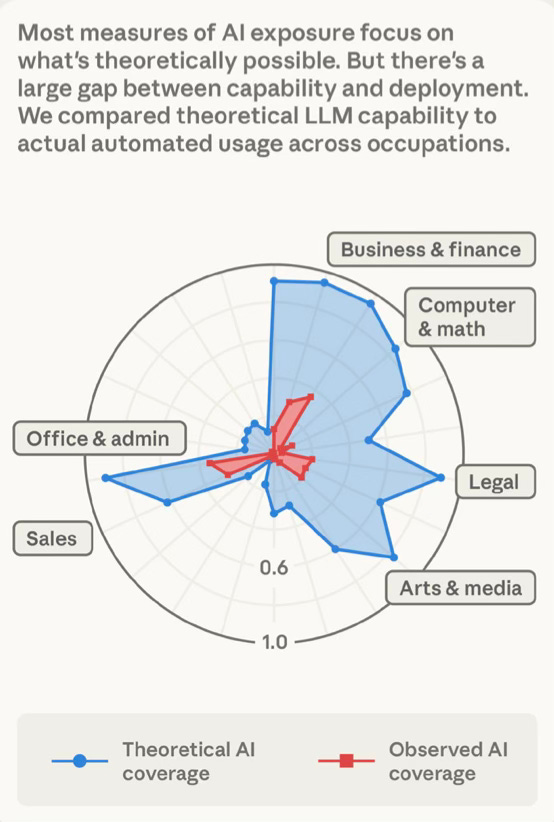
As clearly labeled: blue represents the potential Anthropic sees in specific job categories, and red shows where AI’s impact has already been observed.
For some sectors, the impact has been immediate; for others, the decline in opportunities will be slower. The tech industry, for instance, has already seen a tremendous impact.
Former presidential candidate, NYC mayoral candidate, and entrepreneur Andrew Yang was far more blunt in his assessment of what he thinks comes next. And if we’re all honest with ourselves, it’s pretty clear he’s spot on.

Watching for the Invisible Impact
The important thing to note is that we won’t necessarily observe the impact of these workplace shifts in the same way we might expect. “Replacement” of workers doesn’t automatically mean economic wobbles in the companies that employ them—so job losses won’t necessarily map to broader economic decline.
For instance, last week Block laid off 40% of its staff “because of AI.” There is some debate about whether that’s literally true, but what’s most notable is that CEO Jack Dorsey made these cuts while the company’s performance remained robust.
This makes the potential for loss here more “invisible” if we aren’t paying attention. This piece in Synthetic Civilization explains the impending scenario well:
The Good News: Job Categories That Will Remain Static or Even Grow
There are job categories that will be in demand in the near term, and others we can reasonably hypothesize will remain robust further into the future.
Right now, for instance, there is a severe shortage of electricians—a current deficit of about 300,000—as data centers need to be built. It’s an immediate need that could prove a ready opportunity for any willing and able young person today.
Trades overall will also continue to be a category with “low exposure” to AI—electricians, plumbers, HVAC technicians. These roles require physical dexterity in unpredictable, unstructured environments: crawling through walls, improvising in tight spaces, diagnosing problems with all five senses. Any risk of robots taking over these complex tasks is decades away.
The other “safe” jobs are those requiring in-person human touch, or those in categories that will grow as we have more time to focus on our health and well-being once AI takes over more operational tasks.
A few examples:
Therapists/counselors. While AI can simulate human connection, it isn’t authentic and can’t replace the trust and lived emotional experience that humans bring.
Primary care & emergency physicians. AI is excellent at pattern recognition in diagnostics, but physical examination, real-time judgment in chaotic emergencies, patient communication, and legal and ethical accountability make full replacement implausible for the foreseeable future.
Early childhood educators. Young children need physical presence, emotional attunement, and responsive human caregiving to develop properly. The role is part educator, part caregiver, part emotional regulator—and parents overwhelmingly want humans doing this work.
Custom craftspeople/artisans (furniture makers, glassblowers, jewelers). The “made by human hands” story will only grow in value as the world becomes more automated.
Athletic trainers/coaches. Effective coaching is about motivation, real-time physical observation, emotional intelligence, and relationship. Elite performance depends on a coach who knows a person’s psychology and history—AI tools will support this work but won’t own it.
Veterinarians. Diagnosing and treating animals that can’t describe their symptoms requires hands-on physical examination, pattern recognition across species, and surgical skill. The combination of physical, cognitive, and interpersonal demands—including managing anxious pet owners—is highly complex to automate.
These are just a few examples, but the common thread is clear: the jobs that hold up best against AI share some combination of physical unpredictability, genuine human emotional presence, real-world accountability, and trust-based relationships. AI will become a powerful tool in most of these fields—but it won’t replace the need for human beings.
And that represents both an opportunity for our children and a reason for hope: a future where we can focus more on our very human needs.
Guiding Teens and Young Adults
I have two high school students, both heading to college over the next two years. This has been my guidance to them:
Understand the “language” of technology. Seek to gain firm footing in math (particularly statistics, probability, and algebra) and computer science (coding, algorithms). In the case of computer science, this doesn’t mean mastery; it means understanding the language and how it works.
Master the classics. Many experts agree that a well-rounded liberal arts education—even when combined with other subjects—will be a competitive advantage. The broad context that comes with a wide knowledge base will make engaging with AI even more fruitful.
Find an outlet for creativity. Firing on both sides of one’s brain is an important exercise for the future. Painting, writing, building—all of these will continue to be important endeavors to training our brains.
Consider having a trade in your back pocket. For those of us who remember wood shop, metal shop, or cooking class, there is real upside in acquiring a skill that can be both useful and a source of income. And that doesn’t mean setting the classics aside—the two complement each other well.