

AI Isn’t Eroding Critical Thinking Skills. We Are.
Social media rewards fast, reactive thinking. AI does not. The real risk isn’t AI itself, it’s entering into this new era without the mental habits necessary to succeed. How to reverse the trend...

Who “wins” when it comes to effectively harnessing AI in the future?
Well, it’s the people who think slowly and deliberatively. The critical thinkers who use AI technology to further their thinking rather than replace it.
Unfortunately, fewer of us fit this profile, having feasted on a steady diet of social media with its bite-sized information and addictive emotional highs.
And that’s our problem, not the fault of technology.
In fact, the growing gap between what AI demands and how we’ve been trained to think may be the most significant AI-related challenge families face in the years ahead.
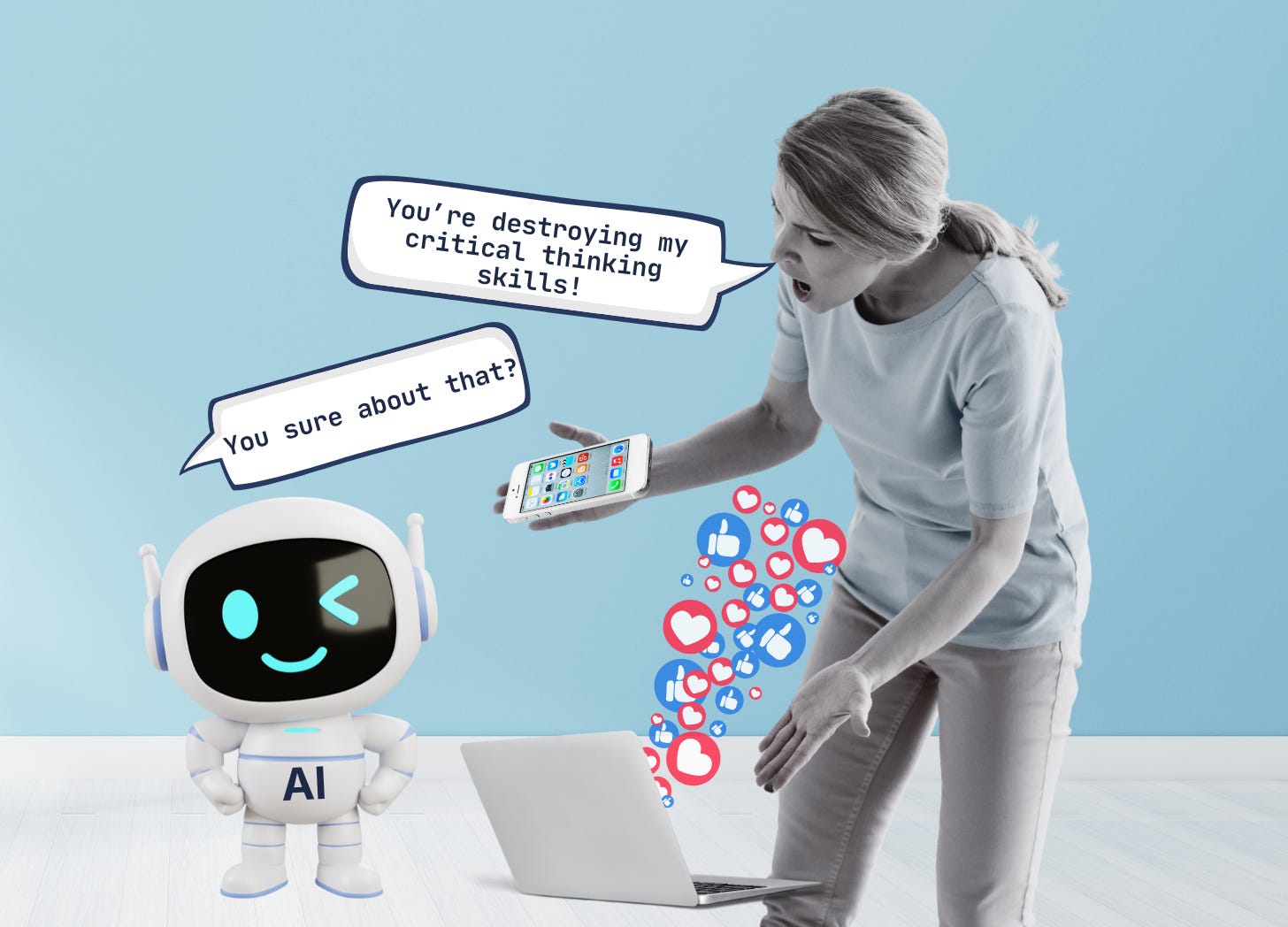
How Social Media Has Rewired Our Brains
Somewhere along the way, we started confusing feeling informed with being informed.
We’ve come to judge news by the emotional reaction it produces, not the insight it offers. Connection and engagement have shifted from in-person discussions to quips (and even threats) delivered safely from behind screens.
Even more problematic: Silence has become something to fill with useless information instead of giving our brains the time to rest and regenerate. Without mental downtime—free thinking, boredom, daydreaming—people can be efficient but not original.
We’ve lost the ability to sit in stillness with a thought, accept uncertainty, or allow our minds the time and space to recover.
Social media isn’t necessarily making us dumber, but it is making us emotionally busy. And emotional busyness destroys exactly the traits we now need most to work effectively with AI: doubt, patience, depth, quiet, and the courage to probe.
So who do we blame for stealing our critical thinking skills? AI? Social media platforms? Online advertisers? Big Tech companies?
The answer, of course, is us.
The next divide won’t be about who has access to AI. It will be between those who use AI to advance their thinking versus those who can’t think without AI.
AI rewards productivity—but human creativity still requires space.
What This Means to Learning
It’s not the introduction of AI technology to schools that’s problematic. In fact, we should embrace the efficiency it brings to teachers, the gaps it can fill in providing tutoring support, and the accommodations it offers to those with disabilities.
But the real problem lies in how AI will reshape our definition of learning itself. That’s at the core of the friction we’re seeing right now. It’s not about banning AI or playing gotcha with kids who use it for assignments. It’s about ensuring we can still reliably measure understanding versus articulation, reasoning versus presentation.
We don’t need to resist technology—we need to focus on how we think and what helps kids do that best.
Practical Steps to Reversing the Trend
We all know we should think more critically about the world around us, spend less time on devices, and avoid emotional reactions to inflammatory content. But there are concrete exercises you can do to counteract these habits and retrain your brain. Here are a few suggestions.
💡 Do one intellectual activity a week that produces nothing
Read difficult text slowly (a challenging book or journal article). Take private notes that you don’t share with anyone. Explore an idea with no outcome, no sharing, no pressure for perfection.
💡 Schedule your news consumption
Pick your sources. Set a time limit. Avoid infinite scrolling. Feeling “up to date” is not the same as understanding.
💡 Practice sitting with boredom and uncertainty
Those empty moments—on trains, in waiting rooms—are not problems to solve. They are critical cognitive recovery time. Fill that time with nothing.
💡 Don’t make decisions based on social media
Social media is like sugar: enjoyable in small doses, harmful as a steady diet. Rage is not insight, and responding is not real debate.
💡 Protect your mental energy
Use your best thinking time for sense-making, not reaction. Your attention is finite—spend it intentionally. Every moment you fill with trivial information diminishes your brain’s capacity for meaningful work.

We Have the Power
The real risk is sleepwalking into a world of extraordinary tools while steadily losing the ability to think clearly, slowly, and independently.
It’s not about how you use AI—it’s about how you think when you use it.
If we protect even small pockets of boredom, uncertainty, and deep thinking—for ourselves and especially for our kids—we don’t just keep up with technology. We stay human in the ways that matter most.
The families who do this won’t simply use AI more effectively. They’ll shape how it’s used—at home, at school, and eventually, in the world. This is how more of us “win” in an AI-led world.