Almonds, AI, and Williamsburg, VA
We're mad about data center water use but ignore the worst offenders. We think urban elites are pushing AI but miss the actual hotspots. How today's AI debates are exposing our societal blind spots...

One of the most fascinating (and even alarming) aspects of the “AI debate” right now is how it’s peeling back the layers of our biases and blind spots—creating new vulnerabilities as a result.
For instance, we’re quick to jump into issues that have activated communities around AI (such as the water needs of data centers) without weighing up the bigger context. In this case, the impact of any industry expansion into communities—or commercial water usage overall (we see you, golf courses and almond producers).

We’re also facing a rapidly widening generational divide, as Gen Z outpaces us in AI adoption (graduation “boos” notwithstanding). This gap will make everything harder, including future regulation.
Dig into the facts behind today’s most popular AI narratives and the truth turns out to be far more complicated than it may seem.
Flood of Water-Related Issues
It’s hard to miss the stories right now about community resistance to data centers.
One of the most passionate claims against these facilities is their water demands. It’s a legitimate concern. It’s also fair to say that many of us know next to nothing about commercial water use regardless of industry. Without that context, though, how do we weigh in on issues like this meaningfully?
For example, did you know the almond industry in just California uses many times more water than all the data centers in the US combined? Golf courses tell a similar story of water consumption—but it’s a story that only makes it to our news feeds every few years (if that).
Even when you dig into how water actually gets used comparatively (as this great overview does), the picture starts to change shape. But the problem is that we rarely get there.
US Rep. Alexandria Ocasio-Cortez recently held up a jar of brown water at a congressional hearing, pressing the EPA over residents’ complaints that a Meta data center in rural Morgan County, Georgia, was responsible for muddy tap water.
The news has received widespread coverage—but more as an AI and Meta-as-enemy story rather than one highlighting the issue of water safety (or availability) overall. Even shocking facts like that more than a million Americans don’t have access to any running water (including more than 56,000 here in NYC) seem to rarely get air time.
More and more, we find issues being called out to make the tech industry the bad guy rather than an opportunity to address bigger issues in good faith and with full context.
As it relates to data centers: The bigger question is whether communities can benefit from data centers and if there is a model for integrating them safely. That doesn’t remove the need to think critically about their impact—but it does mean weighing up the pros and cons in a meaningful, data-focused way (a few good reports can be found here).
Unexpected AI Divides
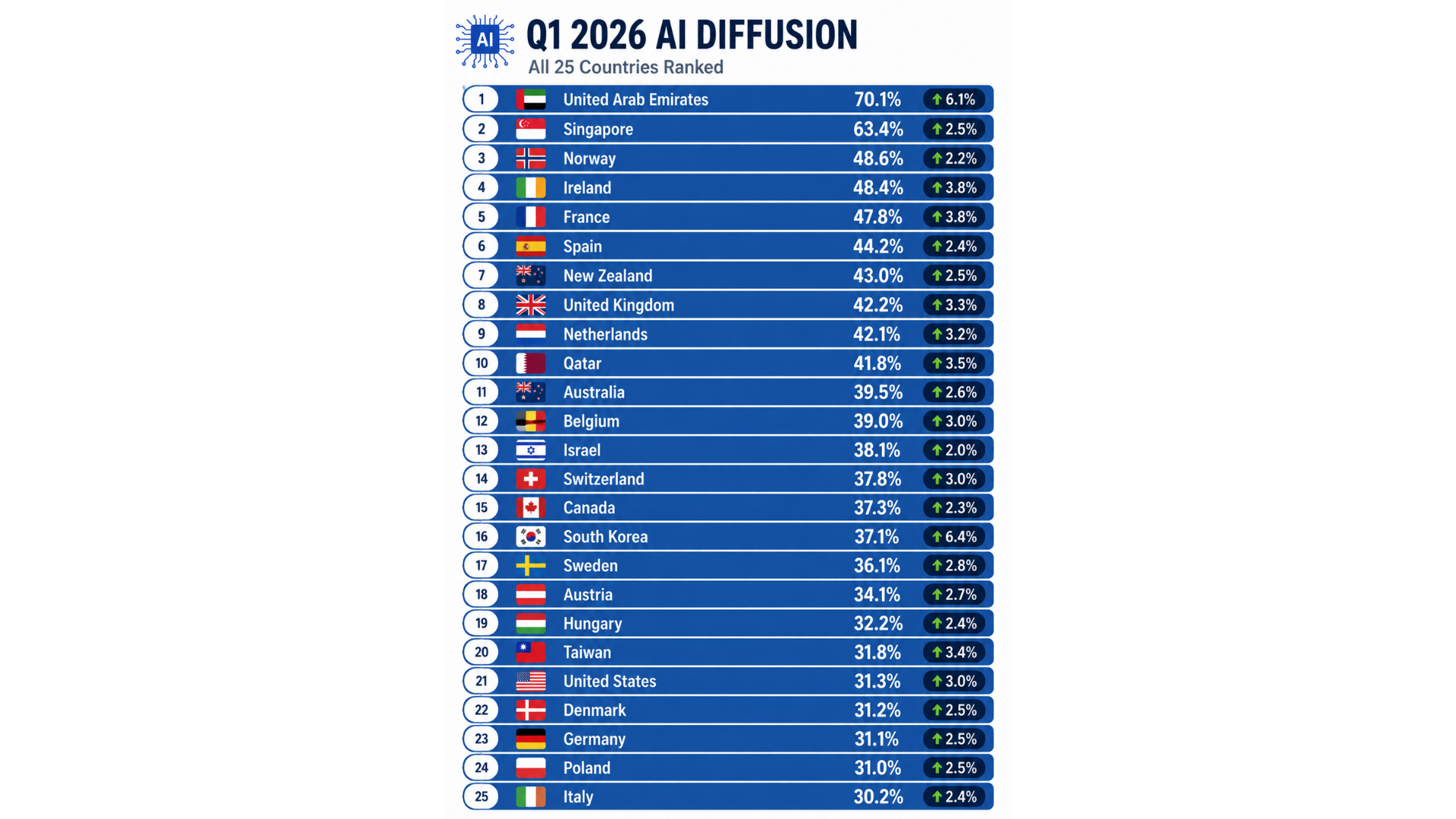
Microsoft recently released an update to its AI Diffusion Report, and surprisingly the results don’t map to the story we are generally being told about who’s driving AI adoption and where it’s flourishing around us.
It also highlights an alarming fact about how we are approaching AI as a country overall. Because while the data suggests that the US leads in AI innovation, we rank just 21st in AI adoption—and well behind a number of countries that we might not expect, such as Norway.
Adoption Doesn’t Mean Uncritical Use
If we don’t teach ourselves to use AI, and think through how it might help or even hinder what comes next, we risk a number of serious future challenges to our safety and prosperity.
It’s also important to note that adoption and competency are not the same thing. Developing digital literacy in kids does not require them to simply learn via a chatbot. That should be obvious, but often gets conflated in anti-AI debates.
I believe that much of our current angst over AI traces back to the choices we made as a society during the dot-com boom. During this peak period of growth in the early 2000s, we celebrated the flourishing of a new “internet industry” without taking digital fluency seriously as a core competency.
All of a sudden, we were using these cool new tools and platforms, but also becoming increasingly comfortable declaring that we weren’t “tech people” when trying to navigate a setting or in discussing a new discovery. We’re now paying for that digital literacy gap.
Gen Z’s Influence Over AI Use
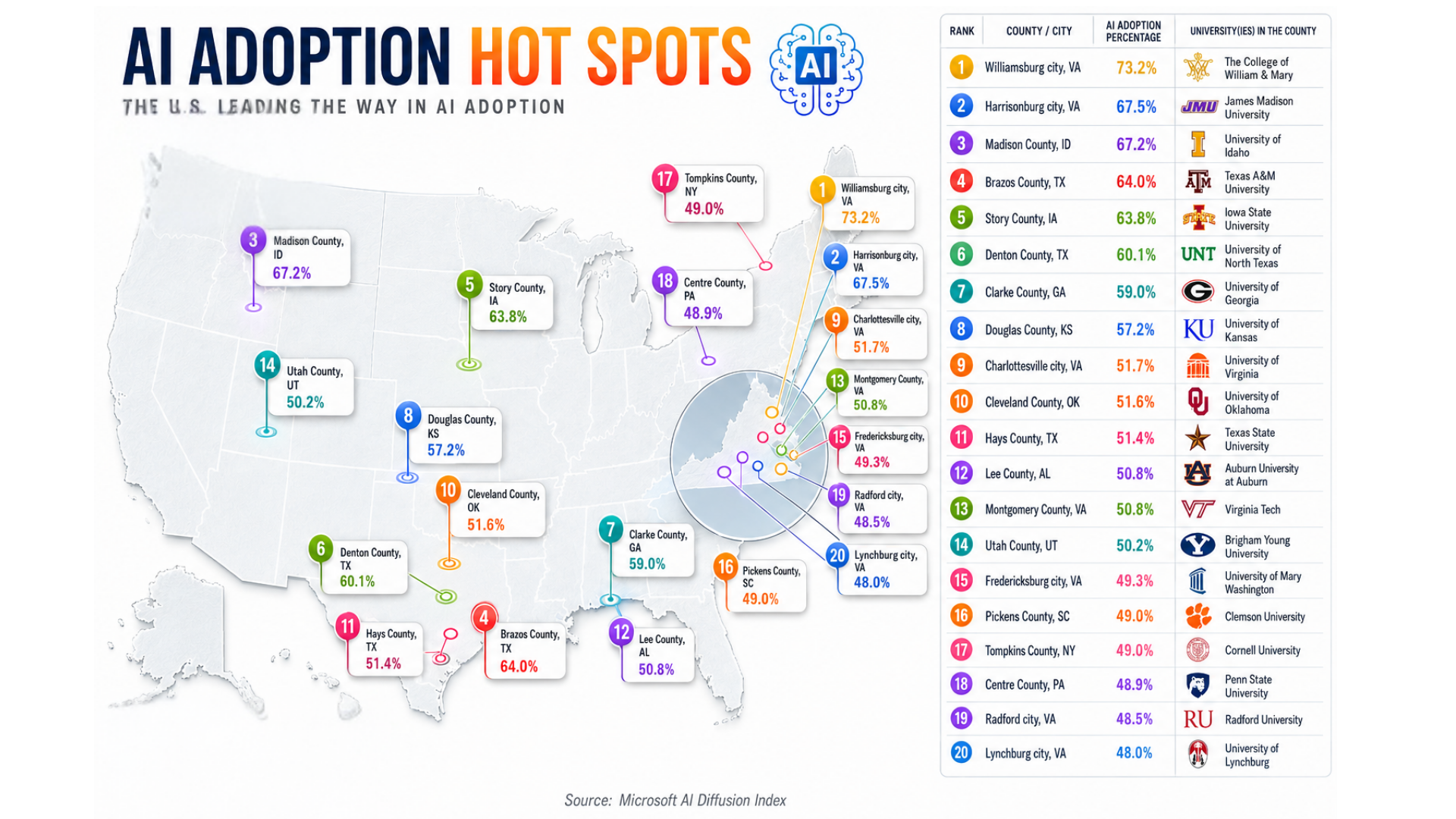
The Microsoft report also highlights an eye-opening fact about AI adoption by at the community level (and by extension generationally). For instance, the flourishing of the technology in college towns. And by flourishing, I mean, complete dominance. Like Williamsburg, Virginia, home to the College of William & Mary, leading the country with a 73% adoption rate.
This fact doesn’t contradict any anti-AI sentiment within the generation of those currently at the university level (because, of course, you can’t meaningfully rail against a technology that you don’t use or understand). But it does show a shifting tide that will meaningful change the years ahead.
Impact on Centers of Influence
These surprising findings have trickled over to the state level too. Unbelievably neither California nor New York crack the top 10 in state AI adoption (California is 7th, New York 13th). The top five states are Maryland, Utah, Texas, Virginia, and New Jersey.
Even within New York, no NYC county makes the US top 20 list. It’s instead Tompkins County—home to Cornell and Ithaca College—that boasts the highest county adoption rate in New York state.
Similarly, while San Francisco County is the top in California (but not even making the top 20 list of counties in the country), it’s neck-and-neck with Yolo, San Luis Obispo, and Santa Barbara counties—each home to a large University of California campuses.
Meanwhile, Los Angeles County—home to our nation’s second most populous city—only ranks 18th in the state and 273rd in the country overall.
The Takeaway
Technology is a means, not an end. When we isolate AI—and out of context—we fool ourselves into thinking we’re solving problems but we’re really just drawing around the edges.
Compounding this is the risk we face of a widening divide in understanding between all groups—from generational splits to gaps in geographies.
Our efforts to create policy and work out what’s best for society are stronger when we start from a shared, factual foundation. From there, we can aim our attention at societal questions that include technology but don’t focus exclusively on it as the root of all evil.
Upcoming NYC AI Event
I’ll be a part of the panel discussion “AI Safety and K-12 - Raising children in the age of AI” on June 12th in NYC. If you are local or visiting, I’d love to see you there! Register here.