


I was at an event last week that was brimming with successful, colorful, creative-industry professionals. After being introduced to an artist acquaintance it took all of a nanosecond before she said: “we need to change the subject because AI makes me anxious.”
Of course I needed to probe just a tiny bit to understand what was making her so uncomfortable. And what was clear is that it wasn’t the technology per se. She was quite confident about the fact that AI would “meaningfully find its way” into her work. The problem was the news and the industry figures making decisions about AI and the future.
The good news is that many of us are finding our way to the things we like or don’t like about AI. We’re doing this naturally by using the platforms. Also good news is that Big Tech needs our adoption/approval/love and admiration. There is no meaningful way to generate revenue via these platforms if the general public doesn’t want any part of it.
The bad news is that they are terrible at courting consumers. I mean, if this was about dating we all would swipe left…
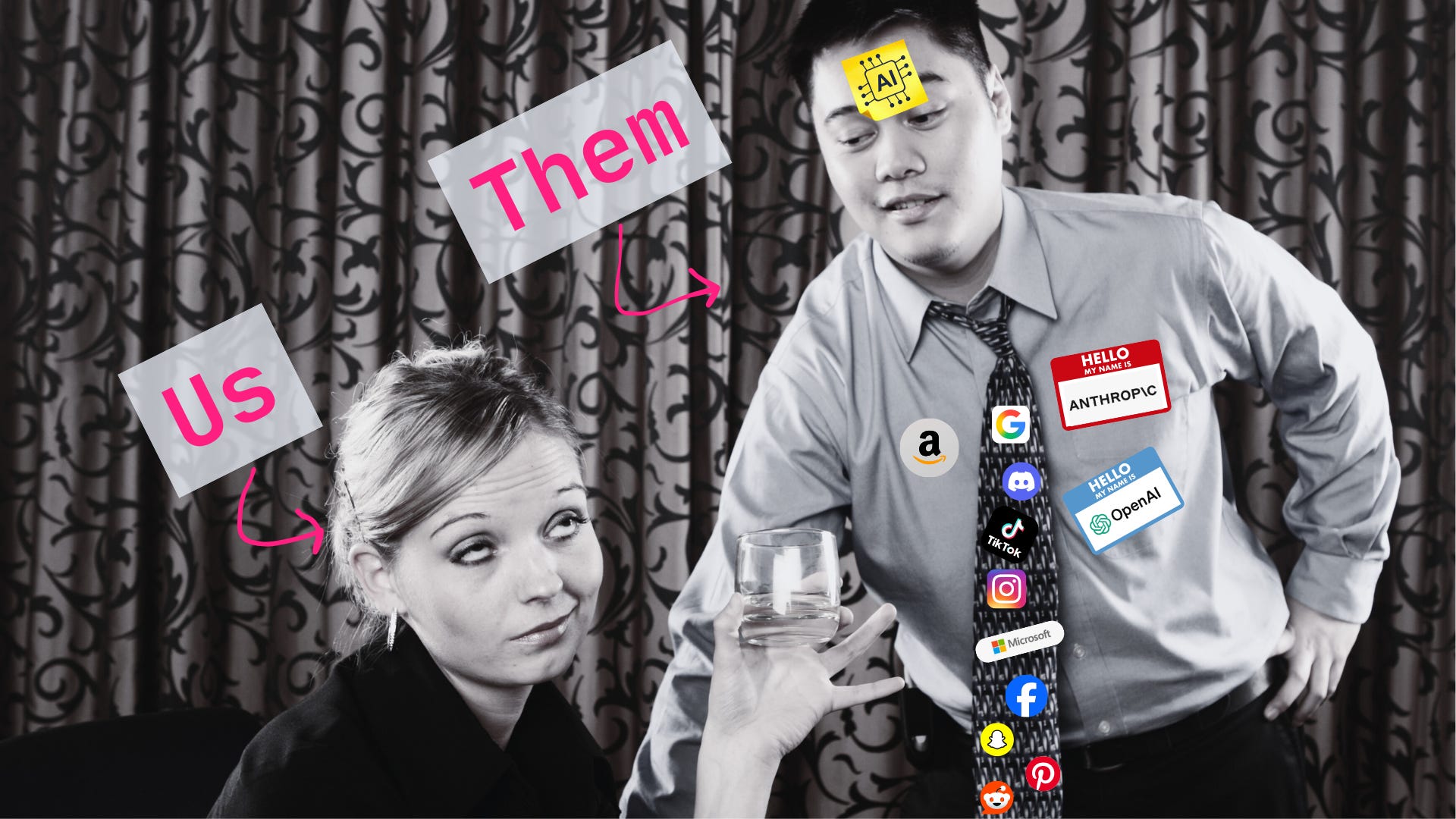
Signs That Our Relationship with the AI Industry is Like Dating (Badly)
🤖 Leaders Warning of Dystopia While…Creating it
What is particularly maddening right now is the way in which some industry leaders like to wax on about the dangers of AI while still pushing forward at breakneck speed.
Case-in-point, Anthropic cofounder and CEO Dario Amodei wrote a lengthy essay about the existential risks of AI and, at the same time, is moving full steam ahead in the AI race. The obvious issue here was best captured by a piece in Futurism, saying:
Plenty of questions remain surrounding the real risks of advanced AI, a subject that remains heavily debated between realists, skeptics, and proponents of the tech. Critics have pointed out that the existential risks often cited by leaders like Amodei may be overblown, particularly as improvements in the tech appear to be slowing.
We should also consider the greater context of Amodei’s verbose warning. The CEO’s company is looking to close a massive, multibillion-dollar round of funding at a valuation of $350 billion. In other words, Amodei has an enormous financial interest in positioning himself as the solution to the risks he cites in his essay.
—Victor Tangermann, “Anthropic CEO Warns That the AI Tech He’s Creating Could Ravage Human Civilization,” Futurism, Jan 28, 2026
☄️ Media Acting Like a Bad Wingman Intentionally Stoking the Emotional Fires
Mainstream media don’t mind the drama because it makes readers click, debate, share content on social media, and elevate a writer or publication in ways that keeps it in the black.
It’s hard to blame them. The industry is shrinking. Just this week The Washington Post laid off 30% of its staff. And it will continue. While AI’s impact is undeniable, consumer trust is plummeting at the same time.
According to Pew Research, in October 2025, 56% of US adults have lost trust in the information they get from national news outlets. And that is down 11% from May of the same year.
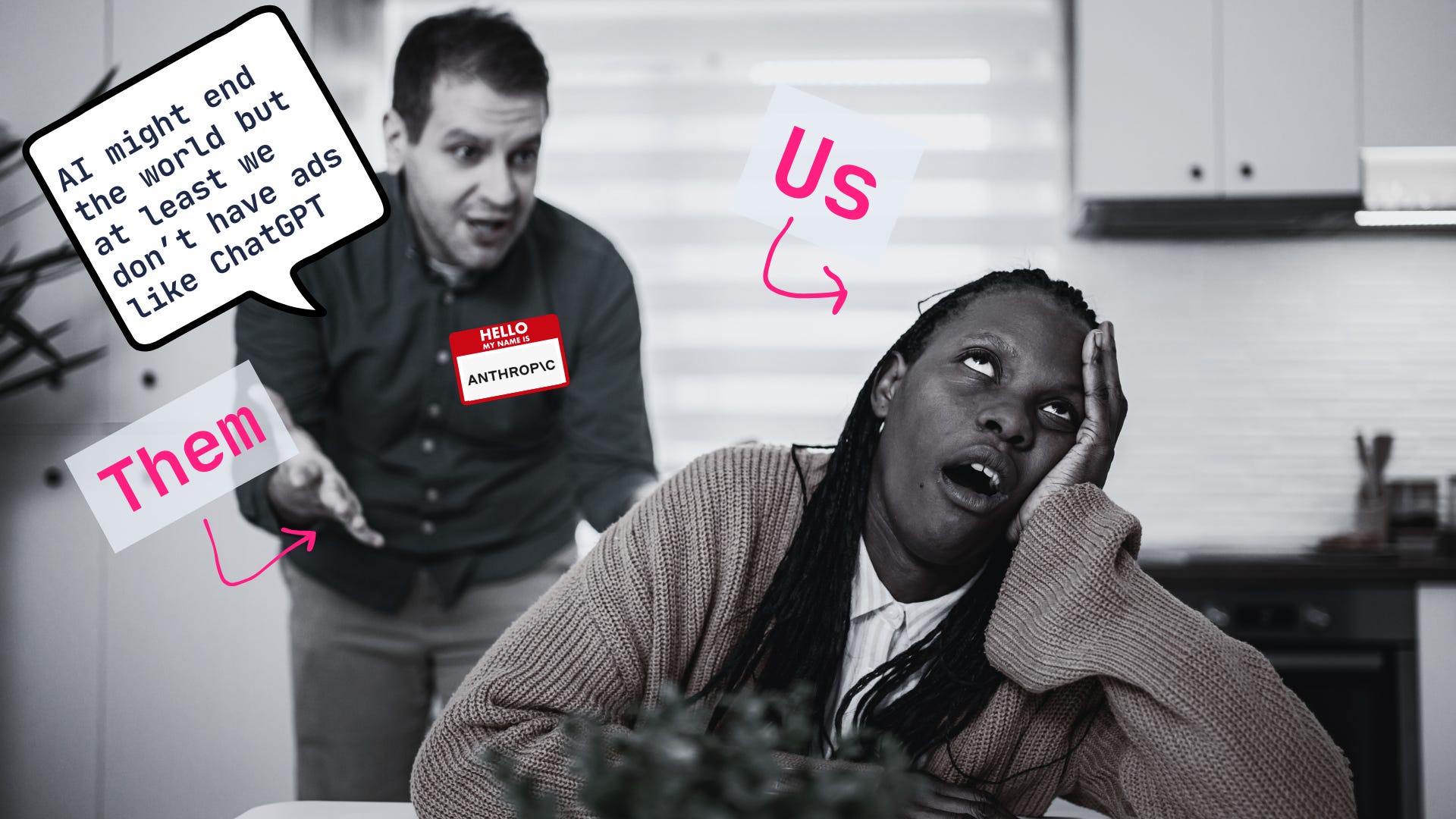
👎 Cringey Courtship Tactics (E.g., Super Bowl Ads)
The AI industry spent big on the Super Bowl and with good reason: they need us to use their tools as the investment in AI is unmatched by revenue. So they really need to court consumers and it doesn’t seem to be working.
Instead of grand gestures (aka Super Bowl ads), we need to have conversations and in the context of our lives. A lot of these advertising efforts felt (in the words of our kids)…cringe. And, in particular, because their moves were so obvious… “AI isn’t that scary,” “The other guy is terrible choose me,” and so on.
So What Should We Do? Well, Choose Ourselves…
This week I spoke with a group of women who write about AI (She Writes AI). Each of us had distinct concerns, different views of the platforms, and varying values that motivate us. We said “I don’t know” and “I feel” a lot.
Because that’s the point: there are no definitive answers, just shades of personal feeling that combine into something that resembles personal agency.
At another event this week, an entrepreneur told me he has multiple iPhones that he uses for research purposes. On one, his “personality” is a 50-something woman. On another, he appears as himself (a 20-something male).
Even as a researcher, he was shocked by the relentless algorithmic targeting and shaping of the messages we receive online.
And this is particularly true of AI-specific messaging. Every story you’re receiving is intended to condition your thinking. So don’t let it. Try to seek out news proactively instead of reactively, and begin to break the mold.
✅ To Use AI is to Find Your Own Love for It
Every single day I hear amazing stories of individuals successfully using AI in their work or personal lives. Often their experiences are more mundane and tactical than news stories would suggest.
Just this week I met a woman organizing research at a charity, a marketer testing ad campaigns, a woman researching medications to take to her doctor, and a friend new to the US using AI to navigate cultural differences in her new home.
This doesn’t mean we should be lax in considering risks or asking hard questions—it means that we can’t get better at understanding AI’s real impact until everyone gives it a try.
The way that those around us are casually and effectively using AI is the real story here. We’re finding it useful; we just don’t quite understand our power to shape it yet.
That’s the story.