

Should Roblox Be Trusted With Biometrics? And Other News This Week
There is a lot to chew on right now; including what digital harm looks like and how to protect kids. I also had an unfortunate clash with Claude highlighting a nagging issue around AI and "nudges"...

This Week…
Roblox Launches “Age-Based” Accounts
One of the most complex issues today is how to protect kids online. At first glance verifying a child’s age and creating a gated experience seems wise (which Roblox is now doing globally).
But are we creating a much larger danger by allowing companies to collect children’s biometric data? I’m definitely in the camp of “yes” here.
We also need to remember that businesses are guided by the bottom line not necessarily by the greater good. With 162 lawsuits pending, Roblox has seen a steep decline in players and revenue.
“How old are you really? Inside Roblox’s new campaign to verify user ages,” NBC News, June 15
“Lawsuit alleges Roblox enabled grooming, exploitation of 11-year-old,” Las Vegas Review-Journal, June 11, 2026
“Is Roblox losing steam? Stock dips after sharp drop in peak users,” Investing.com/Yahoo Finance, January 26, 2026
Despite assurances that their age estimation technology is safe, it does seem upside down to entrust biometric collection to companies that we are suggesting can’t be trusted. Right? 🤨 Even if you give Roblox the benefit of the doubt for trying, the longterm harm of collecting and storing the images of kids can’t be overstated.

“10 (Not So) Hidden Dangers of Age Verification,” Electronic Frontier Foundation, December 8, 2025
“Roblox defends expanded age‑checks after parents raise concerns over errors,” BBC, April 13, 2026
"Roblox’s AI-Powered Age Verification Is a Complete Mess,"Wired, Jan 13, 2026
The UK Bans Social Media for Kids
The UK decided this week that an under-16 social media ban would be imminent —despite poor results in Australia (and a Prime Minister already hanging on by a thread 🤷♀️)
“Why young people say the social media ban is not working six months after it was introduced,” ABC News (Australia), June 13, 2026
“AUSTRALIA’S SOCIAL MEDIA BAN – IS IT WORKING? RESEARCH BRIEFING,” Molly Rose Foundation
“UK: Social media ban for under 16s ‘right diagnosis, wrong prescription’,” Amnesty International, June 15, 2026
A ban on kids using social media also means verification for all—a privacy violation that some adults are just starting to realize.

“UK proposal to restrict youth social media would mandate digital ID verification for all adult users,” DIGG, June 16, 2026
“FIX THE ONLINE SAFETY ACT: The Online Safety Act is restricting freedom of expression in the UK,” Open Rights Group, 2026
What do teens think of the ban? Well, not much, as witnessed by these eloquent, wise, teens interviewed by the BBC…
Claude Scolded Me
There’s been some seemingly dramatic news about Anthropic (Claude’s parent company) launching a new AI model that the US government then quickly banned.
A contact in my network, Kevin Shields, made a good point on LinkedIn that some of these stories are more business wrangling than “proof” of AI’s dangers—but end up creating an aura of unhelpful negativity in the end.
So, I decided to very simply ask Claude to summarize Anthropic’s statement on the issue to ensure I clearly communicate what’s happening.
And, gulp, that did not go as planned…
Claude’s Temper Tantrum
Claude started by telling me that there was no such statement and began railing about misinformation. It also suggested that in sharing said “misinformation” I would betray the intent of my newsletter. More of a recap here:
It’s a reminder that there are people behind AI and they are making decisions everyday about how we interact with the technology. This will be one of the biggest issues to address in the years ahead and we must do our part by pushing back and highlighting these oversteps.
The Data Center Debate Rages On…
After having written about data centers last week, I found this recent piece in The Atlantic to be well timed and worth sharing.
It reiterates some of the context I shared around data center water usage and includes a few interesting additional facts on communities that have found success in welcoming data centers. For instance, Loudoun County, Virginia—a county with more data center computing power than all of Beijing—receives 50% of its tax revenue from data centers that cover just 3% of its land.
So what’s the problem? Well, a lack of transparency for starters. Famed activist Erin Brockovich has asked: “if data centers are so great, why the secrecy.” To help force the point, she has created a map to track these centers and related community concerns.
Brockovich is not anti data centers per se, but rightly sees a problem with how they seem shrouded in secrecy.
A Great Event
Finally, I participated in a fantastically spirited panel discussion around AI, kids and schools last Friday. It was a great illustration of how there is no one “side” in the AI and kids debate. We all may agree as much as we disagree and where that aligns might surprise each one of us.
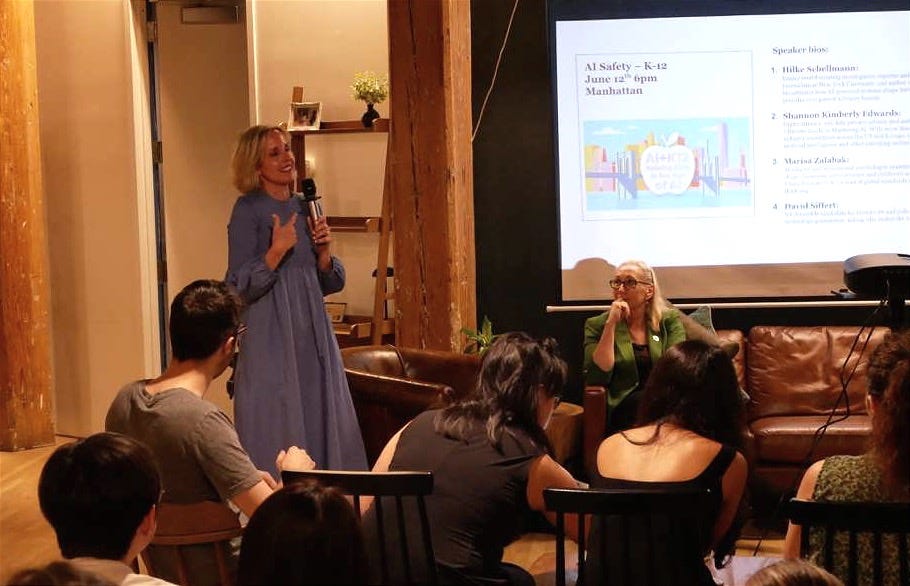
Here is a recap from one of the organizers Elizabeth Safran —
What have you been reading about this week? I’d love to hear more…